|
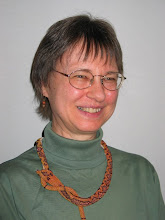
| Photo by Freddie Ott. The other advanced crocheters in the class were Joanne Ivey, who owns a bead shop called Cranberry in Australia, and Akiko Nomura from Japan. My roommate for the class space was Fran Griffith so it was a fun day all around. 
Fran Griffith (photo by Freddie Ott)
Rita finished a snake soon after Beaders Best.

Rita's photo of her finished snake
Akiko also finished hers and Joanne assures me she is not far behind.

Akiko's photo of her snake
I also took a few photos of some of the contest beadwork Friday night so here is a peak at some of the amazing beadwork.
 
I know the name of this artist who made the amazing necklace below, Kris Empting Obenland, because I was lucky enough to finally meet her in the real world.

"Self Portrait" by Kris Empting-Obenland
 
This stunning necklace by Joanne Zammitis called "Atlantis" and yes, those are real sea urchins.
Meanwhile, Don started his day by exploring a protected nature area that was about a 15-minute walk from the hotel.
  
He even found some mushrooms.
After that, he explored Planten un Blomen, the large green space in the city of Hamburg. It has a lot to offer: plants (of course), lakes and ponds, fountains, a Japanese garden, miniature golf and more.
   
A vanilla ice cream cone that was so good it needed to be memoralized in a photo.
 
After the garden, Don joined me at the hotel and we had dinner there with many of our new and old beading friends.
|
Showing posts with label planten un blomen. Show all posts
Showing posts with label planten un blomen. Show all posts
Sunday, October 11, 2015
Hamburg, Day 4: Florencia Snake Class and the Botanic Garden
August 22 was my Florencia snake bracelet class, so I worked (if you can call teaching great students work) while Don continued exploring Hamburg. Here I am helping Rita Lettau, my intrepid student who tackled a snake bracelet with no English. Luckily, I had Marianne, a fabulous translator, to help with communication (plus notice Rita's phone with a German to English translation program on the table-we were covered!)

Friday, September 18, 2015
Hamburg, Day 2
Our next day was Museum day, as we visited 2 of them in one go. But first, here I am finishing a bead crochet sample that I needed for the Florencia class while waiting for the bus.

We got turned around trying to find the Hamburg Museum, and wandered by part of the Planten un Blomen (botanic garden). This tv tower looked like it was straight out of the "The Jetsons."

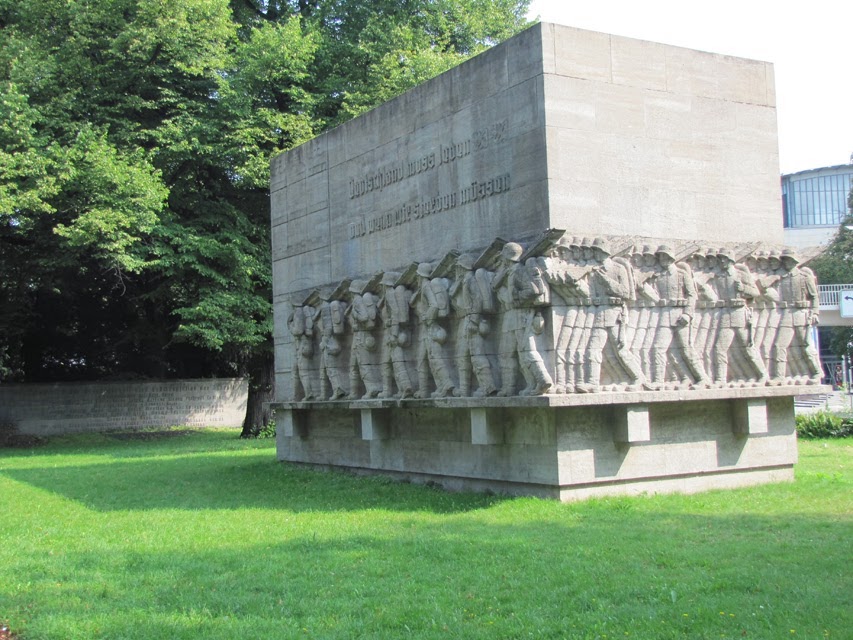
We also wandered by a war memorial from World War II.


We got turned around trying to find the Hamburg Museum, and wandered by part of the Planten un Blomen (botanic garden). This tv tower looked like it was straight out of the "The Jetsons."

We also wandered by a war memorial from World War II.
Finally, we made it to the Hamburg Museum ( Museum für Hamburgische Geschichte), a collection dedicated to telling the history of Hamburg through a multitude of objects like canons, work tools, period rooms, statues, model railroads-all kind of interesting things.

 |
This is a pair of shears that were used to slice off fluff from fulled wool fabric. Since both of our families emigrated to the U.S. from Europe on ships, I was particularly interested in this cleaned-up reconstruction of the steerage section of an ocean liner (where our relatives would have traveled) .  Notice that the compartment is barely high enough for a man to stand up and has little light. The wooden bunk beds were designed to hold 4-6 people and the straw mattresses were aired out once a week. As late as 1887, passengers in steerage had to eat their meals sitting in bed or out in the open on deck. Food was the equivalent of the meager sailors' diet: hard bread, legumes, cured meat, coffee, tea, bread, and butter. Not surprising that many passengers brought their own food for the first few days of the trip.  Another item that caught my eye was a reminder of the "Great Fire" of 1842. The fire burned for 4 days and destroyed a quarter of the inner city including 3 churches, the town hall, and countless buildings. The fire killed 51 people and left 20,000 people homeless. So among the items touched by the Great Fire was a pile of glass buttons that melted into this remaining lump.  Those of us who know something of the history of knitting or war are aware that English and American women knit clothing for "our boys at war," so I found this display interesting. It is a pair of crocheted socks made for a German soldier fighting in World War I. They don't seem too practical to wear with boot so maybe they were meant to be worn as slippers. We took a break to eat lunch on the patio of the museum. It was a lovely place to eat but the large number of bees that came to check out our tasty meals were a bit of a challenge.  After we finished with the Hamburg Museum, we headed to the arts and crafts museum (Museum fur Kunst und Gewerbe), the one museum I definitely wanted to see. It was a stroll through a variety of objects from many periods and styles.  The entrance to the Museum fur Kunst und Gewerbe  This is one of a group of expressionist costumes   A glass peppermill Then it was time to wander down to the Landungsbruken piers and the water.  We took the lift down to the entrance to the Old Elbe Tunnel for pedestrians and vehicles that was opened in 1911 to allow access to the south side of the Elbe River.  Going down was fine but then I made the mistake of agreeing to walk up the stairs. Given my fear of heights, it was too scary to be out on those suspended stairways.   Part of the decoration on one of the buildings on the waterfront. We would love to know the meaning behind the iconography but, alas, there was no explanation so you will have to come up with your own meaning. 
View from ferry number 62
We bought the Hamburg Pass the day before, which gave us free access on bus, trains, and the ferry so we were able to bypass the expensive tourist boats and hop on the Hadag harbor ferry for a ride on the Elbe.
After that, it was time to eat dinner because we were starving. The Landungsbruken area is really quite touristy but we were too hungry to go elsewhere. We avoided the Hard Rock Café and ate at Block Brau Hamburg, a very large brewpub with 3 floors and space for 500. Luckily it was not terribly busy late on a weekday. The food was pretty basic but fine (wiener schnitzel with potato salad, sausage with potato salad, etc.) and Don enjoyed the beer brewed on premise.

View of part of the Block Brau restaurant and some of the brewing tanks
Than it was back to the hotel to end a very long and eventful day.
|
Subscribe to:
Posts (Atom)